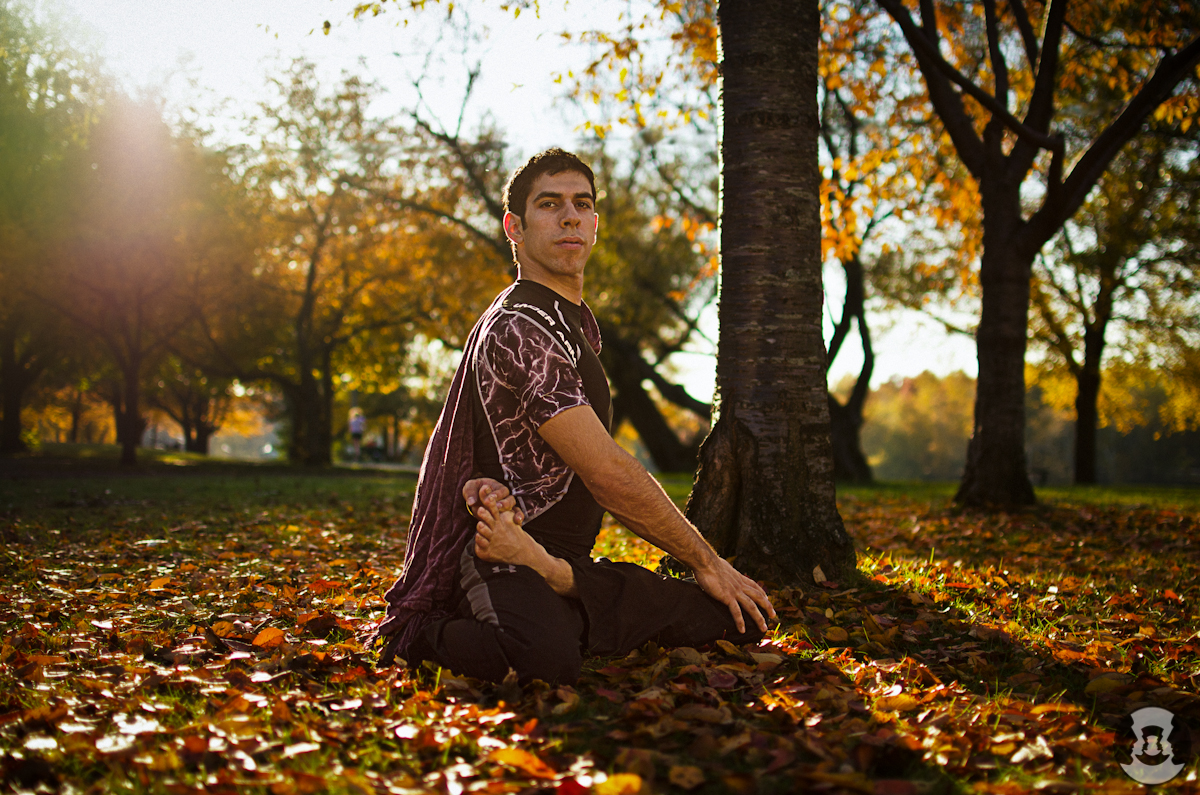
Epic Yoga Playlist

Are you ready to get your vinyasa on?

This playlist is one of my recent favorites with  lots of great upbeat electronica material up front to complement standing poses, and a selection of more melodic pieces to accompany seated work and savasana toward the second half.

Check it out here:

David Magone’s PVYU Playlist

Want to stay updated on all things PranaVayu?  Like us on Facebook!

What songs do you love to move to?  If you’ve got something great, be sure to share!

Upcoming Workshops with David Magone:

March 9 – 11, 2012:   Learn universal principles of Hardcore Alignment at Exhale Spa Boston.  Open to students and teachers from any style.


Oh, My Aching Back!

Yoga has increased in popularity in recent years, and more people are now hitting the mat than ever before. Because yoga provides so many valuable tools for mind body health, more  people are turning to yoga as their primary form of physical fitness with numerous practitioners reporting between four and six days of practice per week spent on the mat.

All in all, I think that this increase in practice is great… I love all things yogic, and I’m really excited to see so many people getting really excited about these things as well.  However,  I’ve also I’ve noticed that this increase in practice volume seems to be creating problems for many people.  I regularly find that those who practice six or seven days per week seem to be more likely to report wrist problems, aches and pains in the lower back, and muscle pulls of all varieties.   I’ve known many a yogi who has had to quit in the middle of a 108 day yoga challenge because their hamstrings were so cooked that they simply couldn’t consider the possibility of another day of forward folding.
When viewed from a physiological perspective, it isn’t  too terribly surprising that these types of injuries are occurring in serious yoga practitioners. Regularity in practice is critical if you wish to transform through yoga practices, but it IS nevertheless possible to have too much of a good thing.  Your body needs time to recuperate after exercise.  Neglect this need, and you will eventually get injured.  To that point Jeff Chandler emphasizes that stretching too frequently can be injurious because  ”Passive stretching can create large tensile loads in the muscle, so it is possible to weaken and injure muscle with vigorous stretching programs. Stretching exercise is like any other training stimulus in that it results in temporary weakening before the body recovers and supercompensates for that activity” (Chandler, 174).

The temporary weakening  that occurs after stretching is no big deal as long as the muscles have time to rest and recover.  It’s also not as much of a problem if you are pursuing a gentler form of practice.  However, problems begin to occur when you repetitively stress muscles, (say for example in by doing an active vinyasa class for 108 days consecutively) without giving them a break by either resting entirely for 48 hours after you practice or by offering training variety in the form of cross-training practices designed to counterbalance areas of potential weakness.

To avoid some of the problems associated with overtraining, Periodization godfather Tudor Bompa recommends that you organize a training program that “stresses the athlete to provide the stimuli for adaptation, [while] alternating rest periods with work periods” (Bompa, 119).   If you wish to apply this to yoga practice, this can be accomplished by alternating days of intensive physical practice that emphasize stretching with days that focus on active rest or strength building and cross-training practices designed to stabilize areas such as the wrists, low back, neck and knees.

In my experience practicing in this way can reduce inflamation, stabilize areas of chronic weakness and decrease the likelihood of nagging injures turning into chronic pain.  If you have some area of chronic discomfort that just won’t seem to go away, then you should definitely consider giving this type of practice planning a try.

So how do I do this?

1.  Alternate what you practice

 Give your body time to rest from intensive stretching by alternating your vinyasa yoga practice with strength building or cross-training practices.   For example, you might consider doing a vinyasa practice on Monday, Wednesday and Friday and strength building/cardio conditioning with kettlebell practices on Tuesday and Thursday.

2.  Stretch in the morning and stretch in the evening. 

  Research suggests that  people who stretch a muscle every day gain range of motion no faster than those who stretch  just three times per week provided that you stretch twice per day.  This is a great opportunity to train smarter rather than harder!  Rather than repeating the same stretching routine every day, shake it up by giving yourself a few days off per week.  Your body will love you for it, and you’ll progress just as quickly.  If you decide to do this, spend a little extra time on those days that you decide to go to class stretching for 15 or 20 minutes at home to release those areas in your body that feel stuck or tight.

3.  Repeat the same practice three times per week for optimal effect

Generally speaking, any physical exercise must be repeated at least twice per week in order to have a transformative effect.   To make sure that your muscles are stretched frequently enough to adapt, consider creating a yoga sequence that you will stick with for at least three weeks.  Practice the  sequence that you create at least three times per week with a few days off for rest and you’ll see good results in no time.

 Does this mean that I should never practice six days per week? 

 Not at all.  It is possible to practice active vinyasa yoga six days per week, but doing so requires a different type of weekly training plan.  Interested?  Check in soon for more details!



Breathe Your Way to a Healthy Heart!

Did you know that  yoga practice can lower the levels of free fatty acids, cholesterol and triglycerides in the blood stream when combined with pranayama?    Since high lipid levels can increase your risk for heart disease, moving AND breathing should form an important component of a preventative maintenance program that includes proper diet, stress reducing lifestyle choices, and mental relaxation techniques.

Not sure of where to start?  Give these two exercises a try!  

The Breath of Equal Duration:  (Sama Vrtti Pranayam)

Find a comfortable seated position.  Sit up tall and close your eyes.  Slowly begin to modulate the overall length of your breath by inhaling to a slow count of four.  Fill your lungs completely, and then exhale to a count of four and empty your lungs all the way.   Once this begins to feel comfortable, expand the count to 5:5, 8:8, etc. as appropriate.

At first practice the Breath of Equal Duration for two minutes at a time.  Work up to five minute sessions as you become more comfortable with the practice.

The Skull Shining Breath (Kapalabhatti Pranayam) 

**This breath is contraindicated for expectant mothers.

This exercise consists of quick rounds of exhales taken through the nose. To begin, inhale to your fullest capacity.  Exhale half of your air.  Once the lungs have emptied halfway, press a quick burst of air out through your nose by pressing your belly muscles quickly downward and inward. To inhale, relax your belly and let your lungs effortlessly fill to the halfway point again.  Practice repeating this cycle of active exhales and passive inhales at a slow rate until you get the hang of it.  With practice, you can take approximately one exhale per second.

Repeat twenty five to fifty times.  Build up to three rounds of fifty repetitions.

*For associated research on this topic, see :The Impact Of Pranayama And Yoga On Lipid Profile In Normal Healthy
 Volunteers.” JEP online 2006;9(1):1-6

Link:  faculty.css.edu/tboone2/asep/PrasadV2.doc

Have a happy practice!

David

Postural Inspiration: Supta Surya Yantrasana (Var.)

I first ran across this variation of Supta Surya Yantrasana while watching some old school Ukrainian Yoga videos produced by A. Sidersky. This incredible stretch is one of a family of postures that are practiced from the reclining or face down position. I really love these variations, so I’ve included all of them in the twisting sections of the PVYU Yoga advanced level syllabi. Truth be told though, you’ll hardly ever see me teaching any of these in class. Because they’re all incredibly challenging to teach in group settings, I usually save them for personal training practices instead.

While Supta Surya Yantrasana targets many areas of the body, I find that it primarily develops range of motion in latissimus dorsi muscles. Placing one leg in half lotus while you do this provides additional stretch to the hips which can also be very helpful when you are preparing to do deeper twists such as Marichyasana D.

If you’re so inspired, give this one a go at home! For optimal affect, try it after backbends, and just before deeper twists.

Reflections for the Aspiring Yogi: 6 Tips for Developing Your Yoga Practice

If you’ve been practicing yoga for a while, it’s very likely that you’ve run across a few postures that just feel stuck. While it’s true that range of motion in some postures can be limited by your physiology, I think that you’ll find that many limitations can be overcome with some good planning and perseverance.

Not sure where to begin? Then follow these six steps to accelerate your transformation!

Tip # 1: Set goals for your practice.

Do you want to focus on better alignment in your poses or is it your goal to touch your feet to your head in deep backbends? Since each of these goals requires a different methodology, clearly defining what you are working toward will make it easier to determine what types of techniques you should use to get yourself there.

Tip #2: Analyze what types of things are preventing you from meeting your goals.

When a posture feels stuck, determining the nature of your limitations can be very helpful. If you are not able to make progress in a posture, try to determine what it is that is inhibiting growth. Do you need to build strength to accomplish the pose or is it flexibility that’s lacking? If you don’t know, check in with your yoga teacher to see if they have some insights to share.

Tip# 3: Create a personalized practice plan that will help you address your challenges.

Once you have determined your overall goals and limitations, create a 45 minute to one hour practice routine designed to counter any perceived imbalances. Make sure to include poses that will strengthen your weak areas and stretch the areas in which you are limited. Keep in mind that most strength and flexibility routines need to be repeated at least twice per week in order to have a positive training effect, so plan on practicing this routine at least two to three times per week.

Tip #4: Work major ranges of motion every other day.

Doing the same exercises every single day can lead to imbalance, muscular exhaustion and injury because your muscles don’t have time to rest and recover. To avoid this, give your muscles time to rest by focusing on backbending practices on Mondays, Wednesdays, and Fridays. Then, switch things up on Tuesdays, Thursdays, and Saturdays by focusing on hip and hamstring stretches.

Tip # 5: Be consistent.

This is the singular most important part of reaching your goals. If your practice is sporadic, you will have a hard time making any progress. To set a rhythm, choose a consistent daily time to practice and stick to it. Transformation takes time, so repeat your weekly practice routine for at least three weeks before switching to another. Remember, it’s better to practice a little bit every other day than really hard once or twice per week.

Tip #6: Journalize

Journalizing creates accountability. To do this, get a small notebook, and create six boxes– one for each day of the week. Give yourself a + for every day that you practice, and a – for those days when you skip out. Jot notes down for every practice recounting what went well and what areas there are to improve upon. Be gentle, but honest. Adjust your practice plan as necessary based on your journal and practice experiences.

The Yoga of Sitting

Every PranaVayu class incorporates at least 15 minutes of meditation into the practice.   One you’ve gotten the hang of it, this can be one of the best parts of the class.  However, if you’re new to the practice, you might find that calming the body and the mind can be very challenging.

In my experience, physical posture is one of the keys to making your meditation experiences more accessible.  The reason that this is the case is that a hyper rigid  posture  can lead to increased physical tension and an agitated state of mind.  Alternatively, a slouching or overly relaxed posture can lead you into the lows of sleepiness and and dullness. The good news is that a solid meditation posture can really help reduce distractions created by both of these extremes and make it much easier to cultivate a peaceful, clear and open state of mind.

Traditional Representation of the Seven Pointed Posture

In PranaVayu Yoga, we use  the Seven Pointed Posture of Vairocana (Buddha of Light) to create a more balanced mental and physical state for meditation.  I originally learned this posture from my guru Lama Migmar Tseten Rinpoche. Physically, using this posture will help you to redirect weight into your skeletal structure and make it easier to sit upright for longer periods of time.

Emotionally speaking, yoga practitioners from the Tantric Buddhist traditions believe that imbalances in the earth, air, fire or water element in the body can also exacerbate mental agitation or dullness.  These practitioners believe that these elements can in some part be balanced by physical posture and often use the seven pointed posture to accomplish this end.

The next time you meditate, try to lessen mental and physical distractions while you practice by integrating these seven points:

To Balance Earth… 

1. Sit with your legs crossed in some comfortable way. 

  • If Vajra posture is too difficult, any cross legged position will do.  You can even sit in a chair if you need to.

2.  Make sure that your spine is straight.

  • To do this, elongate from the core of the pelvis upward through the crown of your head.

To Balance Water… 

3.  Place your hands in your lap with the palms facing up.  Touch the tips of your thumbs together.   

  • The hands should be placed about four finger widths below the navel.
  • This mudra creates a receptive state of mind and deepens concentration.

4.  Let your shoulders be heavy.  

  • To reduce tension in the neck, allow your shoulders to drop away from the ears.
  • Allow your elbows to point outward to the side of the room.  Allowing your outer elbows to feel very heavy can also reduce additional tension from the neck.

To Balance Fire…

5.  Lower your chin slightly

  • To begin, start with your face in a leveled position with relation to the wall in front of you. Once you have found this position, draw your chin downward a couple of inches.  Press your Adam’s apple gently backward toward the spine and upward toward the crown of your head to lengthen the spine upward further as the chin drops down.
  • Physically, this introspective head position can help to prevent mental excitability

To Balance Air 

6.  Hold your eyes halfway open  

  • This posture uses eye position to reduce distractions. The eyes are opened one half-way to reduce the likelihood of sleepiness or lethargy. Holding this position with the eyes can help to reduce mental agitation that arises from external distractions.
  • Don’t worry if this makes your eyes water at first.  Focus on relaxing.  With practice, you will be able to maintain this eye position with ease.
7.  Place your tongue on the roof of the mouth just behind the teeth.  
  • This helps to control the flow of saliva as your meditation deepens.  
Like most things physical, this posture may seem a bit awkward at first.  Practice makes perfect though!  Practice breath awareness from this posture for 15 minutes every day and you’ll get it down in no time.
Have a happy practice!

Postural Inspiration – Ghanda Bherundasana in Padmasana

Hello Yogis!

This week’s posture is a challenging one indeed. The posture, Ghanda Bherundasana in Padmasana comes from our PVYU advanced level II syllabus. To get into it requires a decent amount of upper body strength, back flexibility, and the ability to comfortably hold the legs in lotus while upside down.  The good news is that the balance element looks harder than it really is…since the chin is locked on the floor, it’s really pretty similar to a tripod headstand.  However,  I find that having the chin on the ground makes it slightly more difficult to get the legs to a vertical position to complete the pose.

Here it is:

David Magone demonstrating Ghanda Bherundasana in Padmasana

If you want to try this one, the first step along the way will be to gain some confidence with the formidable pose.  If you missed it, you can check out a tutorial here:  http://pranavayuyoga.wordpress.com/2011/05/31/postural-inspiration-the-formidable-pose/

Once you’ve gotten confident with your balance in the formidable pose you can attempt to thread the legs into lotus position while upside down.  If you’re flexible enough to lie on your belly while in padmasana, you can prepare for this by practicing Simhasana.  For those of you not familiar with this pose, you can see it being demonstrated below by the inimitable Bill Counter (if you’re wondering, the tongue out part is optional).

 Once you’ve pressed into the Simhasana you can increase your range of motion if you focus on sliding the breastbone upward and over the heart in a backbending motion while stretching isometrically backward through your knees.  Overall, this action of engaging the sternum and femur line in this way places more bend in the thoracic spine and gives a solid stretch to the hip-flexors.  Since both of these requirements are present in any inverted lotus posture, I think that you’ll find that using it Simhasana as a preparation pose will make it much easier to get your  legs into lotus while in the formidable pose.

An Alternative Entrance for the Very Brave…

It’s a little crazy, but you can also enter Ghanda Bherundasana in Padmasana from Simhasana.  To do this, you need to roll your body’s weight very quickly forward toward the chest and place the chin on the floor while simultaneously driving strongly downward through your hands.  If you roll quickly enough while doing this, you can use the accumulated momentum that you gather to press all the way upward into the final position.

Note to the wise: Get a spotter for this one.  :-)

Have fun!

Want to learn more about PranaVayu Yoga?  Check out the website for video practices, class schedules and more!  http://www.pranavayu.com

PranaVayu Yoga Playlist 4

Happy Thursday everyone!  It’s been a while since I’ve posted a yoga soundtrack so I thought that I’d send this one out for your listening pleasure.  It’s a little short since I wasn’t able to find a few song selections.  If you want to flesh it out, add the following three songs right after the Massive Attack piece and you’ll be good to go:

Twilight – Delerium
Myth – Delerium
Public Displays of Affection – Delerium
Happy listening!


Get a playlist! Standalone player Get Ringtones

Let’s Get Relaxed! Guided Meditation with David Magone

Everyone experiences stress from time to time.  Letting it get out of control isn’t good for you though!   Research suggests that chronic stress can compromise the immune system and in extreme cases, even lead to high blood pressure and greater risk of heart attack.    Because of these risks, it’s incredibly important that you regularly practice methods designed to help you release stressful energy.

As a yogi, I use yoga and meditation every day to deal with the effects of anxiety and stressful situations.  In my experience, the practice works better than just about anything else when it comes to stress relief.  However, if you don’t know how to go about it, getting started can be rather daunting!  Physical discomfort can make it really hard to sit still, and the mind itself can race so fast that it seems virtually impossible to focus long enough to experience even a slight degree of mental clarity.   Because of this, I find that many yoga practitioners choose to not practice meditation at all or relegate it to a few minutes of brief silence at the end of a class.

Because meditation is so important for stress relief, I’ve formulated a curriculum that will make it easier for you to get started with the practice.  Overall, our approach centers around three essential points:

We use preparation to make meditation easier 

In PranaVayu Yoga, we use preparation to make it easier to meditate.  Every class is formatted to in a way that makes it easier to succeed with the practice.  The combination of  breathing exercises, movement and concentration practices that we use alternatively calm the nervous system, strengthen and stretch all the areas that are required to maintain correct seated postures and ease us into meditative states by gradually turn our attention inward.  The end result is that many students who have never been able to experience peace through meditation find themselves able to do so.

Our approach affects the body and the mind 

The meditation techniques that we use provide a very effective way to reduce the physical and mental effects of stress.   The fast paced nature of our lifestyle make is so that that many of us continually live on edge and the effects of stress on our society are rampant.  Insomnia, reduced resistance to disease, and high-blood pressure can all be exacerbated by heightened levels of stress.  The PranaVayu approach to meditation gives us a practical tool to mitigate these affects and can improve overall health and mental well-being in those who practice.

Our methodology is organized for understanding

Meditation doesn’t need to be overly complicated in order to be effective.  To that end, our approach is formatted in a way that helps you understand the pre-requisites necessary for a good meditation practice, the methods by which meditative experiences can be achieved, and an overview of the different types of mental states that you might experience while you practice.

All PranaVayu students begin their meditative journey by learning to consciously relax the body.  The body scanning techniques that we use to calm the body are referred to as Savayatra (traveling around the corpse).  Because these techniques are so effective for stress relief, Savayatra is taught at the end of every PranaVayu class.

Check out the clip below for a fully guided 15 minute savayatra meditation that you can do at home.  If you’re really stressed, practice once in the morning and once in the evening daily.

Guided Meditation with David Magone

One Armed Handstands Anyone?

Summer is in full bloom which means that there are lots of great outdoor spaces available for practice!  For me, this is the best time of year to work on crazy moves like the one armed handstand.  I find that practicing in a grassy yard or on the beach is much more forgiving than a hardwood floor which makes me feel much less concerned when I invariably topple out of my feeble attempts at this pose.

Originally, I cut this one from the PranaVayu syllabus because I thought that it was too challenging for most normal classes.  Recently though, I ran across a picture of my friend Tiffany Cruikshank rocking the posture out.  Inspired by her, I decided to add it into our advanced level II syllabus for those of you who are inclined to attempt such crazy adventures.

Haven’t seen it before?  Check out Tiffany doing the pose here:

Tiffany Cruikshank demonstrating the one armed handstand

So how do I practice such crazy moves?  

It goes without saying that the handstand is prerequisite to this.  Once you get to the point where you can hold that for five to ten breaths, the secret is to work up to the point where you can take a straddle split from the handstand.   With your legs in this position, you’ll be better able to shift your body’s weight onto one one hand without toppling over.  Once you’ve shifted in this way first practice coming onto the fingertips of the non-weight bearing hand for five breaths.  Once that is going smoothly, then lift the hand for the full expression of the pose.

Check out this clip for a video tutorial:

What about using the wall?  

Using the wall at first can be helpful for strength building, but depending on the wall makes it nearly impossible to develop the balancing aspects of the pose.  If you want to balance without the wall, you need to get rid of the wall!  Because of this, move to the middle of the room as soon as you’ve you’ve built enough strength to hold yourself upright.

Happy practice!

David